
Key takeaway
Great copywriting starts with swiping what already works: study proven headlines from masters like John Caples and Gary Halbert, rewrite them for your audience, and build a swipe file before attempting to create anything original.
Updated : Refreshed with a key takeaway summary and an FAQ section for clearer answers and AI-search visibility.
Oh wow.
Pirate.
What does a pirate knows about Copywriting?
Probably not a thing.
But if a pirate was to learn copywriting, he will be a helluva good writer.
Why?
Read on to explore!
1. Plunder!
Well, I said learn from the pirate, not BE a pirate (this coming from Pirate with Pen….)
Assuming you are new to copywriting, you will often question yourself..
Where do I start?
Is this piece I wrote good?
What is a good headline to use?
And specifically, how do I create NEW for my clients?
Don’t.
Yes, it is important to create NEW, especially when you feel the need to impress.
NEW offers.
NEW services.
NEW products.
NEW processes.
But just.. don’t.
In each and EVERY business, there exist resources that have been working for that specific industry.
Find them.
Use them.
Milk them dry.
Don’t go a thousand different directions trying to create something NEW just for the sake of it.
In the pirate language, we call it plunder.
And in the world of copywriting, we call it Swipe (or ethical plunder).
We are not talking about directly copying others’ words. That is called Plagiarism.
What you are doing here is to study what has been working..
Rewrite it..
And make it our own.
That’s swiping.
Here’s one famous example from John Caples
They Laughed When I Sat Down At The Piano – But When I Started To Play
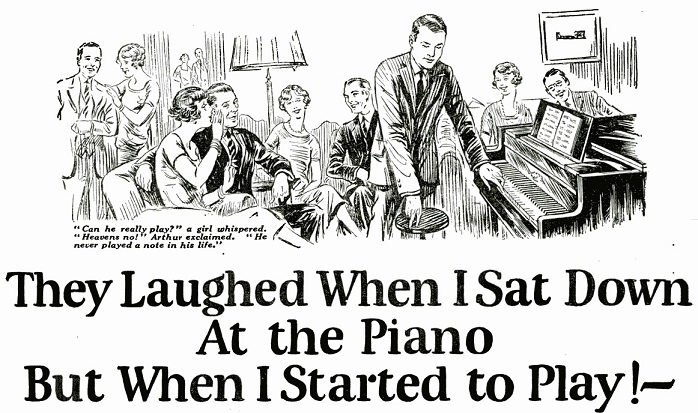
You can use this as a Swipe for your project:
They laughed when I accepted the copywriting job – But when I started to write!
They laughed when I was creating my first digital product – But when my sales came in!
See how this successful headline can be fun-to-use (and swipe)?
Of course, this style of writing might not suit audiences of every different industry, so you need to go back to rule #1 of copywriting, know your audience.
Just to throw in another example from Gary Halbert:
Have You Ever Wondered What You Would Look Like With A “Milion Dollar Smile”?
You can rewrite it in many different ways:
Have you ever wondered what your smile will look like with Accounting XYZ?
Have you ever wondered why using XYZ pen will get your client to sign the deal?
The same swipe concept can be used across all your marketing tools if you’ve done your research.
You want to find that THING that is already proven to work.
What is the suitable tone for the audience in the software industry?
What are the swipes that have been working well for client XYZ’s competitor?
What kind of emails do they send?
How long is the sales letter competitor ABC used?
And along the way, you will gain more experience and eventually come to your own sense on what’s working for who.
Adapt and reuse.
There’s no good reason not to.
Along the way
Don’t reinvent the wheel.
Be a pirate.
2. Eyes on the gold!
It is natural that a pirate always has its sight set on the gold.
But what’s the gold for a copywriter?
What’s our treasure?
The audience.
(If you’ve guessed “the pay of a copywriter”, I am disappointed in you.)
The audience is your ultimate gold.
You need to have your virtual eyes fixated on your audience!
Here we go again, the first rule of copywriting.
Knowing your audience.
You can’t market to everyone. It’s just not possible.
People buy what they want, not what they need, and you simply can’t assume everyone needs it.
But you are not knocking on their door physically, so you can’t market to each of them individually.
So, what can you do?
Create a persona for your audience!
This persona is a fictional character that has all the common traits of your target audience.
And I am going to show you how by asking the 7 questions below:
- Who is your specific target prospect?
- What is the nature of the problem you are trying to solve for them?
- When do they experience the problem?
- Where else does the problem affect them (negatively)?
- Why can’t they solve the problem by themselves?
- How have they tried to solve it but failed?
- What if the problem can be solved?
There.

7 powerful questions to get you started on building the persona of your target audience.
Through this series of questions, you will be able to shine a spotlight on an audience member who represents your ideal target.
And when you have nailed down their interests, behavior, demographics, job, income, etc, you can tailor your messages to them.
You are no longer writing to anonymous John Doe.
You are writing to ONE person.
Someone that you knew intimately.
Their preferences, needs, wants, and traits.
That, my friend, is ONE step closer to your prospect taking action.
Because now, they feel important.
That you care about them.
From there, your eyes are well on the gold you seek.
And whatever you are pitching might just be what they want and need after all.
3. Have a good time!
Yo ho ho!
Pirate knows a thing or two about having fun while working.
After all, in the middle of the vast ocean, you have nothing but to entertain yourself.
Similarly, as a copywriter, make sure you are enjoying the journey!
Yes, the process is not easy.
All the researching.
Learning new methods.
Trying to get into the head of your prospect.
Making sure your copy sound like a 5 minutes work.
Keeping your copy engaging.
Not everyone knows or appreciate how long it took to come up with a very good tagline or a good story.
It might also involve a lot of rewriting and tiring research.
But when you are done?
Boy, it feels good.
The rewards are more often than not beyond a good payout.
When you finally see your product being launched and life being changed for the better, nothing beats the satisfaction.
And that, my friend, is the same feeling as that time when Captain Jack finally found his treasure after a long journey.
FAQ
What is swipe file copywriting and how do I use it ethically?
Swiping means studying proven copy that already works, rewriting it in your own words, and adapting it to your audience — not copying verbatim (that is plagiarism). For example, John Caples' classic headline 'They Laughed When I Sat Down At The Piano' can become 'They laughed when I accepted the copywriting job — but when I started to write!' The goal is to find what resonates, then make it your own.
How do I create a target audience persona for copywriting?
Answer seven questions about your ideal reader: who they are, what problem they have, when they experience it, where else it affects them, why they can't solve it alone, how they've tried and failed, and what life looks like if the problem is solved. These answers let you write to one specific person rather than an anonymous crowd, which dramatically increases the chance they take action.
Why does copywriting feel so hard for beginners?
Beginners feel pressure to create something entirely new — a new offer, new format, new angle. The post argues that is the wrong goal. Every industry already has proven copy that works. Start by researching your competitor's tone, email length, and sales letter structure. Adapt and reuse what's already performing. Experience and original instinct develop naturally over time from that foundation.


